Lanterns for Peace remember victims of atomic bombings on anniversary
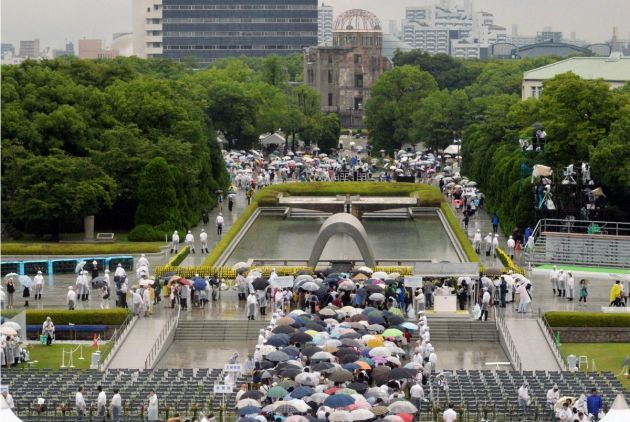
There has only been one war in which atomic bombs have been dropped.
That was at the end of the Second World War II when on Aug. 6 and Aug 9, 1945 the United States dropped atomic bombs on Hiroshima and Nagasaki, killing over 200,000 people, prompting Japan's surrender.
The consent of the United Kingdom was obtained for the bombing, according to Wikipedia.
In Geneva, an interfaith Lanterns for Peace ceremony was held Aug. 6 at Chapelle Notre-Dame, organized by Pax Christi in Switzerland and the Interreligious Platform in Geneva, the World Council of Churches reported..
Inspired by lantern ceremonies held each year in Hiroshima, the campaign invites communities around the world to organize local commemorative events using traditional lanterns as symbols of remembrance, peace, hope, and nuclear disarmament.
"The Lanterns for Peace floated each 6 August on the river in Hiroshima are individual beacons of compassion and hope," said Jonathan Frerichs, Pax Christi International representative for disarmament, UN Geneva.
"Eighty-one years into the nuclear age, these lanterns are also a reminder that nuclear weapons are still everyone's problem. Abolishing them will require sustained and collective actions, small and big."
Marianne Ejdersten, WCC director of communication, honored the memory of those who lost their lives and paid tribute to the survivors of Hiroshima and Nagasaki.
"Let us never forget! Let us never repeat! Let us protect lives," she said. "Let us always remember Hiroshima. Nagasaki."
She urged people to speak out of love for the world and in obedience to the God of all life.
"Churches are not alone in upholding the sanctity of life," she said. "Because we do not want nuclear weapons used against us, our nation cannot use nuclear weapons against others."
The uranium bomb detonated over Hiroshima on Aug. 6 had an explosive yield equal to 15,000 tonnes of TNT.
It razed and burnt around 70 per cent of all buildings and caused and caused increased rates of cancer and chronic disease among the survivors, according to ICAN, an organization that lobbies for the banning of nuclear weapons.
The bomb that exploded over Nagasaki three days later was a slightly larger plutonium bomb and levelled 6.7 sq. km. of the city and killed 74,000 people by the end of 1945.
Ground temperatures reached 4,000°C (7,232°F ) and radioactive rain poured down.
The cities of Hiroshima and Nagasaki were chosen, according to Wikipedia, were chosen because they were large urban areas that also held significant military facilities following extensive early mass bombing of other Japanese cities such as Tokyo, and Osaka.
The United Nations Secretary General, António Guterres, said that 81 years ago, Nagasaki became a symbol of humanity's capacity for destruction.
He said in a message read on his behalf, "We are living through a period of profound geopolitical strain.
"Trust is eroding. Norms that have helped prevent catastrophe are being tested.
"The decades-long trend in nuclear arsenal reductions is reversing."
Guterres warned that the global norm against nuclear testing is under threat, noting that worldwide military spending jumped to $2.9 trillion in 2025.