Space news: Saturn's moons and rings formed during dinosaurs era
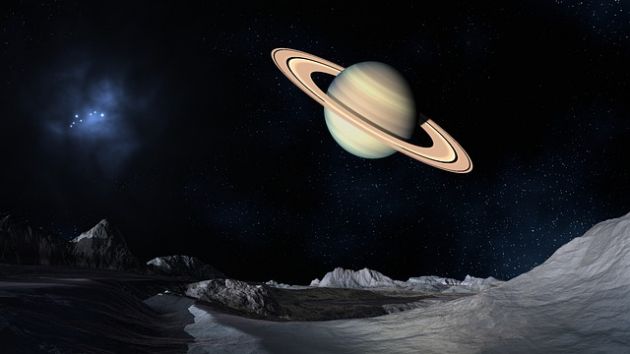
The moons and rings of Saturn might have been formed a mere 100 million years ago, a recent study reveals. These make them even younger than some dinosaurs that lived on Earth.
According to researchers from the Search for Extraterrestrial Intelligence Institute (SETI), their computer model showed evidence that the inner moons and rings of the second-largest planet in the Solar System are a relatively modern creation. Saturn itself and the other planets were formed just 4.5 billion years ago, which is not so long in astronomical terms.
The team analyzed the orbital data from the planet's moons, allowing them to discover the age of Saturn's rings and moons. Their analysis pointed out that the moons orbiting around Saturn have to share the same space, making them affect one another. Their orbits stretch out and grow over time. Based on this perimeter, the younger moons should have more ordinary orbits than the older ones.
"Moons are always changing their orbits. That's inevitable," said Matija Cuk, the lead researcher. "But that fact allows us to use computer simulations to tease out the history of Saturn's inner moons. Doing so, we find that they were most likely born during the most recent two percent of the planet's history."
Additionally, they found that the orbits of Tethys, Dione, and Rhea, considered the most important satellites of the planet, "are less dramatically altered than previously thought."
The researchers were able to create simulations through the help of NASA's Cassini mission data. Their tests revealed that the moons, except the faraway ones like Titan, were likely to have been borne 100 million years ago, which is the same time as Earth's Cretaceous Period — the era of the dinosaurs.
Additionally, Cuk has a theory regarding the cause of the recent birth of Saturn's inner moons. "Saturn had a similar collection of moons before, but their orbits were disturbed by a special kind of orbital resonance involving Saturn's motion around the Sun. Eventually, the orbits of neighboring moons crossed, and these objects collided. From this rubble, the present set of moons and rings formed," he explained.