Pope Leo speaks on Gaza, Ukraine and hopes for Christian unity in plane press conference
Pope Leo XIV has, in an on-flight press conference from Istanbul to Beirut on Nov. 30, emphasised the need for a two-state solution to the Israeli-Palestinian conflict and the possibility of a truce to end the war in Ukraine.
The Pope concluded a three-day visit to Turkiye, which he called "a wonderful experience," according to America Magazine, the Jesuit Review.
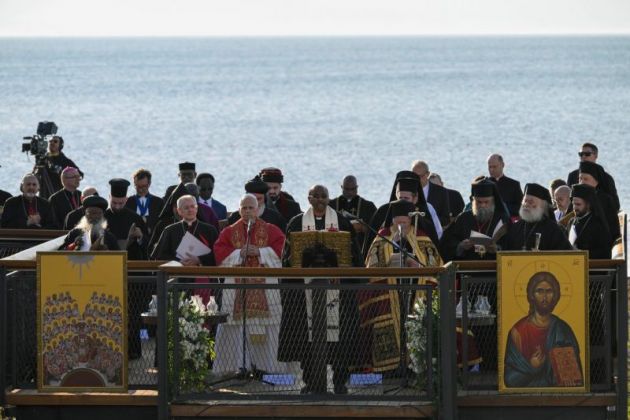
He recalled that "the primary reason for coming to Turkey was the 1,700th anniversary of the Council of Nicaea, and we had that magnificent celebration, very simple and yet very profound, on the site of one of the ancient basilicas of Nicaea to commemorate the great event of the agreement of the whole Christian community on the profession of faith, the Nicene Creed."
The Nicaea gathering took place when the Eastern and Western churches were still united.
They split in the Great Schism of 1054, a divide precipitated largely by disagreements over the primacy of the Pope.
But even today, Catholic, Orthodox and most historic Protestant groups accept the Nicaean Creed, making it a point of agreement and the most widely accepted creed in Christendom and the World Council of Churches,which represents Anglican, Orthodox and Protestant traditions, attended the commemoration.
Pope Leo and Ecumenical Patriarch Bartholomew I of Constantinople signed a joint declaration at the Palace of the Ecumenical Orthodox Patriarchate in Istanbul, Turkey, on Nov. 29, 2025.
The two leaders signed a joint declaration at the Palace of the Ecumenical Orthodox Patriarchate in Istanbul, formerly Constantinople.
The text rejects the use of religion to justify violence, urges global efforts toward peace, supports cooperation among believers of different faiths, and entrusts a suffering world to God with renewed hope in the Holy Spirit.
The Pope and the Patriarch, who is considered first among equals among Eastern Orthodox bishops, reaffirmed their shared commitment to dialogue aimed at restoring full communion between the Catholic Church and the Orthodox Churches.
They called Christian unity a gift from God, they encouraged clergy and faithful to pray and work for the fulfillment of Christ's prayer "that they may all be one."
Delivering a message, Pope Leo acknowledged that we live in a time marked by may tragic signs yet we are linked by a profound bond.
"In this way, we are all invited to overcome the scandal of the divisions that unfortunately still exist, to nurture the desire for unity for which the Lord Jesus prayed and gave his life," said Leo. "Today, the whole of humanity afflicted by violence and conflict is crying out for reconciliation."
- 'MEANING OF NICEA TODAY'
World Council of Churches general secretary Rev. Jerry Pillay, during a commemoration of the 1,700th anniversary of the First Ecumenical Council of Nicaea and an ecumenical prayer held Nov. 28-29 in Iznik (ancient Nicaea) and Istanbul, reflected on what Nicaea means today.
Speaking before heads of churches and Christian world communions, Pillay spoke on "What Nicaea means to us today: Sharing reflections and proposals."
"Without question, the Nicene Creed is the most widely used and therefore the most important common Christian creed," said Pillay. "This became very clear at the Sixth World Conference on Faith and Order, which in its meeting at Wadi El Natrun in Egypt in October commemorated the 1700th anniversary of Nicaea."
He said that today, the call for a common witness of the churches is made even more urgent by the challenges of our time, Pillay, a Presbyterian, noted.
"To confess the Nicene faith is to accept a vocation: a calling to embody the truth we proclaim in our deeds," he said. "Throughout history, the Nicene confession has bound Christians together across cultures and centuries."
On the flight from Istanbul to Beirut Pope Leo responded to questions from two Turkish journalists: One asked about Turkey's role in peacemaking and the actions of Turkey's President Recep Tayyip Erdoğan on behalf of world and regional peace, according to America Magazine.
A second asked whether the Pope had talked with President Erdoğan about the situation in Gaza and the proposal of the Holy See of two states for two peoples, and about his hopes for a truce in Ukraine and a faster peace process in Gaza.
Pope Leo responded in English: "Certainly we talked about the two situations. The Holy See for many years has publicly supported the proposal for the solution of two states.
"We all know that at this moment, Israel does not accept the solution of two states, but we see it as the only [option] that could offer a solution."
"We are also friends of Israel and we try with the two sides to be—let's say—a mediating voice that can help them come closer to a solution with justice for all," he continued. "We spoke about this also with President Erdoğan and he is certainly in agreement with this proposal. Turkey has an important role that it could play in this."
The Pope also noted Turkiye's role in navigating a peace process for Ukraine, where, he said, "President [Erdoğan] helped a lot to convene both sides" in recent months.
"Unfortunately, we've not yet seen a solution, but today there are concrete proposals for peace, and we hope that President Erdoğan, with his relationship with the presidents of Ukraine, Russia and the United States, can help in this sense to promote dialogue [and] a ceasefire, and see how to resolve this conflict."