World churches' head visits South Korea, meets its president
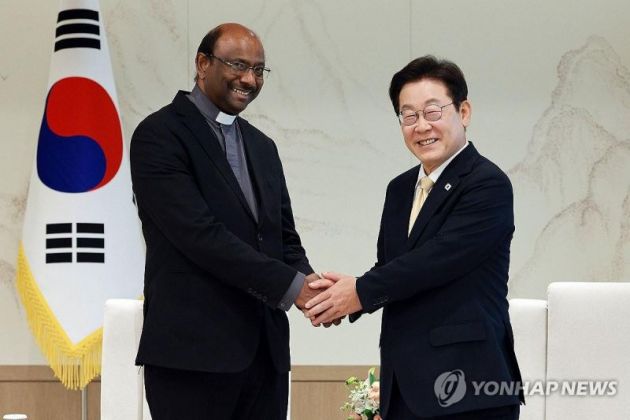
The World Council of Churches head, Rev. Jerry Pillay, has paid a courtesy visit to the South Korean president Lee Jae-myung in Seoul, where the two agreed to work for peace and improving relations in the divided nation.
Pillay made the visit on August 11, accompanied by Peter Prove, international affairs director of the WCC, and Rev. Hyojin Kim, coordinator for the WCC's Pilgrimage of Justice, Reconciliation, and Unity.
With them were the leadership of the National Council of Churches in Korea.
Lee took office June 4 this year.
According to the WCC website, President Lee expressed his deep appreciation for the WCC's contributions to defending the Constitution and advancing democracy.
He affirmed his hope that the WCC's work for peace and solidarity across the world will continue, and that the WCC will also accompany them in improving relations between the two Koreas.
Pillay said, "The meeting with President Lee was very encouraging and strengthened a greater desire and resolve to work towards reconciliation and peace, not only within the Korean context but in the world at large.
"The positive view and commitment from the president for dialogues with the North open great possibilities and hope for all Koreans."
Pillay underscored the importance of remembering the history of solidarity and the sacrifices made in defending democracy and expressed the hope that Christians from North and South Korea would continue to meet in the spirit of people-to-people solidarity.
He prayed that just as Korea will be remembered as a nation that has blossomed into a vibrant democracy, so too will genuine peace blossom on the Korean Peninsula, where Korea is divided into the North and the South.
The WCC general secretary congratulated President Lee on his election and expressed that the people of South Korea have great hope and expectations from his leadership.
H noted that they have placed great trust in his leadership for safeguarding democracy and pursuing the hope of eventual reunification.
South Korea has a population of some 52 million people according to the CIA World Factbook. Of them, about 23 percent are Christians, with Protestants making up 17 percent and Catholics 6 percent; Buddhists account for 16 percent, and "nones" account for 60 percent.
Since the Korean War of 1950-1953, the country has been divided into the pro-West South Korea and communist North Korea, where civil liberties are severely restricted.