Holy Edicule news: Restoration works expose Christ's tomb for the very first time in centuries
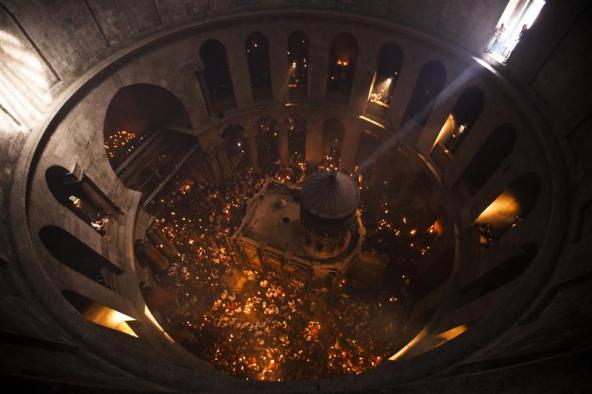
The original surface of the tomb that Christians believe to be that of Jesus Christ was unearthed for the very first time in centuries recently, giving believers an idea as to how the holy site looks like.
It was last week when archaeologists dug the Christianity's holy site as part of the restoration process commissioned by the National Technical University of Athens at Jerusalem's Church of Holy Sepulchre. According to the archaeologists, Christ's tomb, which is otherwise known as the Holy Edicule, is made up of a burial bed made of limestone and is encased in protective marble that protects it from pilgrims who wish to take a piece of the actual limestone.
During the initial stages of their work, the archaeologists only discovered a layer of filling material beneath the first layer of the marble encasing, and eventually, the second marble layer, which bears a decorative cross. However, when the researchers were already about to re-seal the first layer of the marble slab 60 hours after discovering the second layer, it was when they discovered the original limestone surface of the burial bed of Christ, according to National Geographic.
The Holy Edicule was first classified as a holy site back in 326 A.D. and is a popular destination for more than 4 million pilgrims and devotees every year. According to stories, it was Queen Helena, mother of Christian Roman emperor Constantine, who initiated the excavation of the burial place of Christ while she was in Jerusalem.
As those who worked on the excavation discovered three crosses and some iron nails, each of the discovered crosses were held over dead bodies that were waiting to be buried. Then, when one of the corpses returned to life after a cross was placed above it, it was then confirmed which cross belonged to that of Christ.
The recently concluded restoration on the Holy Edicule opened the doors to any living human to get a glimpse on how Christ's burial site looks like as no records nor illustrations speak of its appearance for centuries.
The holy site has been a target of destruction for the longest time and almost got destructed completely back in the 1800s because of fire.