Religious persecution and security failure in Nigeria's Middle Belt highlighted in report
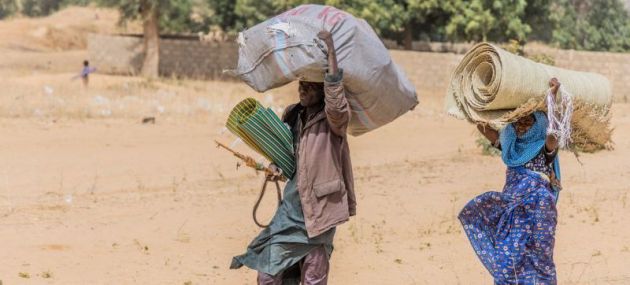
Nigeria is Africa's most populous nation with more than 240 million people of who slightly over half are recorded as Muslims, with Christians not far behind, while some reports have recorded Christians facing persecution in parts of the country.
The west African's country's Middle Belt is the epicenter of a religious persecution and security crisis that is too often described in language that obscures conditions on the ground a recent think tank report has revealed.
According to Open Doors, in Nigeria, Christians suffer significant and severe persecution – to such a degree that Nigeria has been the most violent place in the world for followers of Jesus for several years.
In northern Nigeria, 12 states have implemented Islamic law, creating a system where Christians live as second-class citizens, and conversion from Islam can be severely punished.
And a recent report by Equipping the Persecuted is titled Crisis in the Middle Belt: Religious Persecution and Security Failure in Nigeria.
It says, "Nigeria's Middle Belt is the epicenter of a religious persecution and security crisis that is too often described in language that obscures conditions on the ground.
"Armed groups raid predominantly Christian farming communities, kill and abduct residents, burn homes and churches, destroy food stores, and drive survivors from their ancestral lands."
-- ACUTE DANGER AREAS
According to the report released on September 18, TruthNigeria's field reporting identifies the most acute danger in Benue, Plateau, and Southern Kaduna, with significant pressure also reported in Taraba, Nasarawa, Niger, and Kwara.
It says that during a single week in September, TruthNigeria documented at least 35 deaths and more than 70 abductions across multiple states, while warning of potential coordinated attacks on churches, schools, and youth service camps.
The report says violence in Nigeria is driven by multiple armed groups, including Fulani ethnic militant networks, and traditional terrorist organizations (i.e. Boko Haram, ISWAP, Ansaru, and Lakurawa).
Together, these actors perpetrate killings, abductions, displacement, extortion, and attacks on civilian communities across the country.
"Kidnapping victims in Nigeria often endure torture, starvation, and brutal treatment while in captivity. Women and girls face an additional risk of sexual violence.
"Boys and young men are not typically taken to serve as child soldiers, but they are frequently beaten, tortured, forced into labor, or held for ransom under harsh conditions."
Equipping the Persecuted says that kidnappers use videos of hostages to pressure families into paying ransoms, forcing many households to sell everything they own, leaving families destitute, and some ultimately end up in Internally Displaced Person (IDP) camps.
The stakes are not abstract. Equipping The Persecuted (ETP) recorded 4,216 Christian deaths in Nigeria between January 1 and September 8, 2026.
This represents an average of 16.8 deaths a day, or approximately one death every 86 minutes.
On September 10, TruthNigeria documented the killing of eight Christians in Ayilamo, Benue State.
The report says that because those deaths had not yet been incorporated into the master casualty registry by the reporting cutoff date, this report retains
4,216 as the auditable minimum. The actual total is therefore higher. [2]
"Kidnapping data in Nigeria is neither comprehensive nor fully reliable.
"Although reported kidnappings are often highest among attacks carried out by groups such as Boko Haram, Islamic State West Africa Province (ISWAP), and Lakurawa, these incidents are more likely to be documented by government authorities and security services.
-- FULANI MILITANT ACTIIVITY
In contrast, says the report kidnappings linked to Fulani militant activity in parts of the Middle Belt, particularly Plateau, Southern Kaduna, and Benue, are often believed to be underreported.
Fear of retaliation, limited access to authorities, says the report and mistrust of government institutions frequently discourage families from reporting incidents.
"While jihadist groups frequently target Muslim as well as Christian communities, many of the underreported kidnappings in the Middle Belt disproportionately affect Christian populations," says the research group.
Equipping The Persecuted says in the report, "Why U.S., U.N., and Nigerian Security Policy Must Confront the Fulani Ethnic Militia and Protect Vulnerable Christian Communities."
Accordingly, Fulani-linked actors caused 2.5 times more recorded deaths than Boko Haram and ISWAP combined in 2025 and 4.2 times more in 2026 within NTT's verified incident series.
The Fulani are one of the worldʼs largest nomadic pastoral communities.
The report says that since the jihad movements of the early 1800s, some militant factions associated with Fulani-led Islamist movements have sought to expand political and religious control in parts of Nigeria.
It says that the Fulani influence expanded significantly during President Buhariʼs administration, aided by policies that were favorable to cross-border movement from neighboring countries.
"Attacks against Christians began to increase dramatically during Buhariʼs term, which allowed Fulani politicians and military personnel to take control of Nigeriaʼs security apparatus," the report says..
"Meanwhile, the traditional terrorists like ISWAP broke off from Boko Haram and are directly connected to ISIS."