Nigeria facing crisis of religious violence, according to monitoring group
Nigeria is facing a terrifying crisis of religious violence and according to recent estimates, targeted violence has claimed the lives of nearly 53,000 Nigerian civilians since 2009, says the U.S. Commission on International Religious Freedom (USCIRF).
The year 2009 was the year the USCIRF first recommended Nigeria's designation as a Country of Particular Concern (CPC), noting that some 21,000of those live have been claimed in the last five years alone.
In its 2026 annual report, the USCIRF examines the religious environment in various countries, including Nigeria.
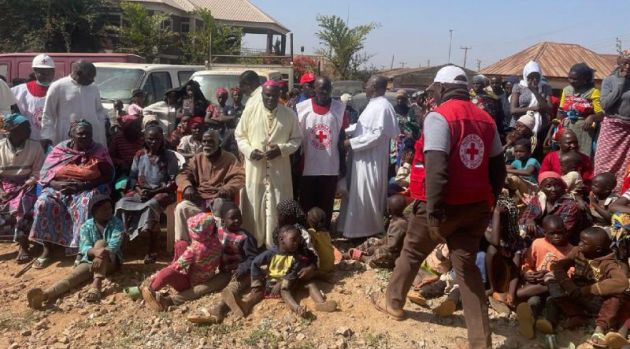
The violence has also forced millions of people to flee their homes and communities to find safety in camps and other shelters for internally displaced persons.
"The unfolding catastrophe is the outcome of a lethal confluence of trends: religiously motivated extremist violence; economic and ethnic tensions, long left to fester; corrosive, state‑level blasphemy laws; and years of both inadequate response and pervasive corruption from the Nigerian government," says the USCIRF report.
And a new report by the USCIRF contends that armed Fulani militant groups have carried out widespread killings, church attacks, abductions and violent land invasions targeting Christian and Muslim communities across Nigeria.
- NONSTATE VIOLATORS OF RELIGIOUS FREEDOM IN NIGERIA
The report, titled "Nonstate Violators of Religious Freedom in Nigeria: Fulani Militants," was released in May.
In addition, Zenit, the Catholic news agency, reported in 2025 that 100 churches are attacked every month and 32 Christians are killed every day in Nigeria.
USCIRF estimated that around 30,000 armed Fulani militants were responsible for some of the "most visible and deadly attacks on religious communities."
The US monitoring body said that the dynamics in Nigeria have fostered "an environment of rampant fear and unchecked religious attacks, abductions of schoolchildren, and killings."
Among the 2025 tragedies cited by USCIRF was one on a still night in November, gunmen charged into the dormitories of St. Mary's School in Niger State at 2:00 a.m., burning a statue of the Virgin Mary as they seized 303 children and 12 teachers in the country's worst‑ever mass school abduction.
That was just days after kidnappers swept away 25 girls from a school elsewhere in Niger state and 12 from a school in Borno.
Other instances cited:
■ Amaye was a food vendor in the village of Kasuwan‑Garba in Niger. In August, a verbal altercation with a customer spiraled into accusations that Amaye had insulted the Prophet Muhammad.
This allegation prompted a vigilante mob to seize her from her stall and set her aflame, murdering her on the spot.
■ In September, Father Matthew Eya of St. Charles Catholic Church in southern Nigeria's Enugu State was returning home from his pastoral duties when unidentified gunmen pulled up on a motorcycle, shot out his tires, and then executed him there in his vehicle.
■ The threat of violence from Boko Haram militants has driven thousands of families from their farms and homes in recent years; as one Muslim farmer told BBC News in October, standing on her farm in northeastern Nigeria from where she and her family had fled:
"There is fear—we fear for our souls."
- MASS ABDUCTIONS
Meanwhile, said USCIRF an interminable stream of mass abducons by bandits or extremists—some of whom hold their captives indefinitely—has traumatized religious communities in north and central Nigeria since 2009.
It cited the example of Leah Sharibu, a young Christian woman whom Islamic State in West Africa Province seized in 2018 and who remained in captivity throughout 2025.
Then there were the 18 Muslim women and children whom militants kidnapped in September as the victims prepared for morning prayers in Zamfara.
"This year's Annual Report cover reflects Nigeria's dire realities as such: its two largest religious communities, Christians and Muslims, have long shared their lives with each other, with followers of traditional African religions, and with many others."
The report says they now face an existential struggle and a dangerous confluence of armed conflict, nonstate violence, state restrictions, and societal challenges.
"These dynamics threatened religious freedom and millions of lives across not only Nigeria but also many parts of the African continent throughout the year," says the report.
Nigeria's religious mosaic underscores the gravity of the in some parts of the world to religious bigotry and violence.
"The north is home to an estimated 40 million Christians — alongside 76 million Muslims — while the south counts 70 million Christians and 24 million Muslims.
Yet despite this balance, Emeka Umeagbalasi, a criminologist and researcher and head of the International Society for Civil Liberties and Rule of Law, contends that the Nigerian state has been complicit, if not actively facilitating the advance of radical Islamism.
"The project is no longer to govern or reform Nigeria," he said, "but to force the nation into submission to radical ideology."
Islam and Christianity are the two main religions practiced in Nigeria.
The country is home to some of the world's largest Muslim and Christian populations, simultaneously, according to Wikipedia.
Nigeria is divided roughly in half between Muslims, numbering around 56 percent, and Christians, who account for 43 percent of the country's total population.
Worldometer puts Nigeria's population at 242 million, Africa's most populous nation.