World churches group to work closer with UN Refugee Agency in a year of severe crisis
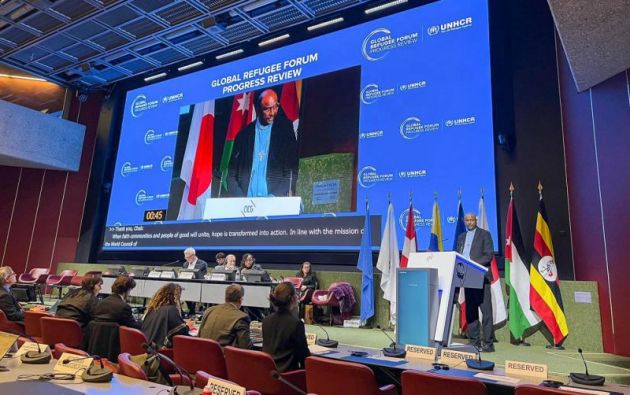
World Council of Churches general secretary Rev. Jerry Pillay has told a Global Refugee Forum Progress Review 2025 plenary session that when faith communities unite, hope is transformed into action.
Speaking at the UN in Geneva on Dec. 17, 2025, Pillay noted it was the mission of the World Council of Churches to speak and act together on matters of faith and social justice.
"We reaffirm our shared commitment to be agents of hope to protect those forced to flee, particularly those rendered invisible by the crises of our time," said Pillay.
"What does it mean to bring hope to the most vulnerable: stateless persons, children, and women with disabilities caught in situations of conflict or disaster, stripped of identity, protection, and dignity?"
Pillay described how the WCC and UN Refugee Agency (UNHCR) will work to establish a financial consortium— called the Multi-Religious Fund for Protection and Ending Statelessness—for philanthropic and in-kind contributions, appealing jointly in a spirit of solidarity and shared responsibility.
In his final public address before his mandate ends on Dec. 31, Filipo Grandi sharply criticised the "incredibly abrupt [and] very deep funding cuts and the hardship they have created around the world," adding:
"No one should tell us they have not caused loss of life. They have already caused loss of life."
Grandi said the cut in funding was first made by the United States, then by other donors.
For example, U.S. contributions to UNHCR so far in 2025 amount to $840 million, down from $2.1 billion in 2024.
Grandi noted that contributions to UNHCR are voluntary and countries cutting are not doing anything against the law "but doing it against common sense."
In a Dec. 15 speech at the UN in Geneva, Grandi said 2025 was "A year when refugees were frequently vilified, scapegoated in so many places.
"With their suffering cynically used by traffickers for profit, and their situation by politicians to gain votes for the next election."
Speaking for the churches, Pillay, a South African who is a member of the Uniting Presbyterian Church in Southern Africa, said, "We are not starting from zero.
"We already have a powerful example of what is possible."
Pillay said the United Methodist Committee on Relief has contributed of $100,000 to support refugee participation in the 2027 Global Refugee Forum.
"This demonstrates what faith communities can achieve when they act together," said Pillay.
"Today, we invite others to join us in this shared mission—so that faith may continue to be a force not only of hope, but of tangible protection, justice, and lasting change."
Pillay, in a Special Ceremony of Global Alliance, then signed a Letter of Intent with the UN Refugee Agency to deepen collaboration, particularly related to stateless people.
The formal agreement, in the preamble, notes that the UN Refugee Agency and the WCC "share a deep commitment to upholding human dignity, promoting peace, and protecting the world's most vulnerable populations."
Both organisations recognise the urgent need to revitalise efforts for stateless people, whose rights and access to protection have deteriorated amidst significant global funding constraints.
The Letter of Intent establishes the mutual commitment of the UN Refugee Agency and WCC to raise global awareness of statelessness and its human impact; strengthen advocacy for nationality rights, legal identity, and inclusive citizenship; mobilise resources, and encourage coordinated action.
"This collaboration will contribute to a wider joint process aimed at developing a multi-year fundraising and advocacy platform, as discussed by the leadership of both organisations," reads the letter.
"By connecting humanitarian action with the moral authority, global reach, and advocacy power of faith communities, both organisations commit to advancing a world where every person belongs—and no one is left without a nationality.